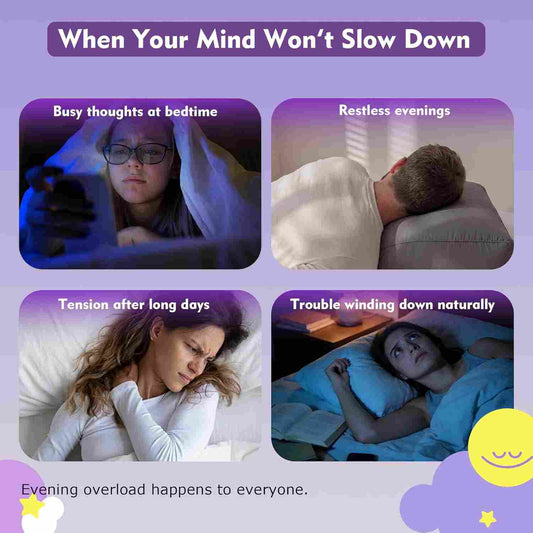
The reader in mind here: people in their thirties juggling work, young children and a training habit that keeps slipping. Career and family both peak at once, and sleep is the resource that gets traded away first.
There is a mechanism section, a practical section, and a section on where support stops and a doctor begins. Nothing here is a promise about sleep. Sleep quality is set by timing, light, temperature and caffeine, in roughly that order.
Where sleep fits, biologically
None of this is complicated once it is separated from the claims around it. Magnesium and apigenin support the wind-down side, and they help only when the timing habits are in place.
That is the whole mechanism, and it is a supporting role rather than a starring one. It pairs with caffeine before noon and a consistent wake time, which is the lever most people skip.
Running sleep through a normal week
-
Check what the label actually states per serving. An evening format taken with your last meal, as a daily habit rather than a rescue.
-
There is a window involved, and it is wider than most labels imply. The mornings, because that is the only hour nobody else has claimed.
-
Do not stack six bottles on day one. Pick the two that match your actual problem and run them properly.
If you only change one thing after reading this, make it the timing rather than the dose.
If you take nothing else from this page, take the part about consistency. Everything else is detail.
Where this page stops
This is a collection page, not a clinic. Heavy snoring, waking gasping, or falling asleep while driving needs a proper sleep assessment. If you are relying on caffeine to function, get a check-up rather than a stronger coffee.
These statements have not been evaluated by the Food and Drug Administration. This product is not intended to diagnose, treat, cure or prevent any disease.
Keep reading on sleep and calm
The questions we get most
How much sleep is in a daily serving?
What matters with sleep is the amount per serving, not the headline on the front of the bottle. If the ratio or the extract strength is missing, that tells you something too.
What is the most practical way to take sleep?
For people in their 30s, the practical answer is the same slot each day, so it stops being a decision. Missing a day here and there is fine; missing a fortnight is not.
Who should not take sleep?
Medication interactions are the main thing to check, and a pharmacist can do that in a few minutes with sleep in hand. Any symptom that is new, persistent or worsening deserves an appointment rather than another formula.
One shelf, one job: everyday nutritional support, with the amounts printed rather than implied.