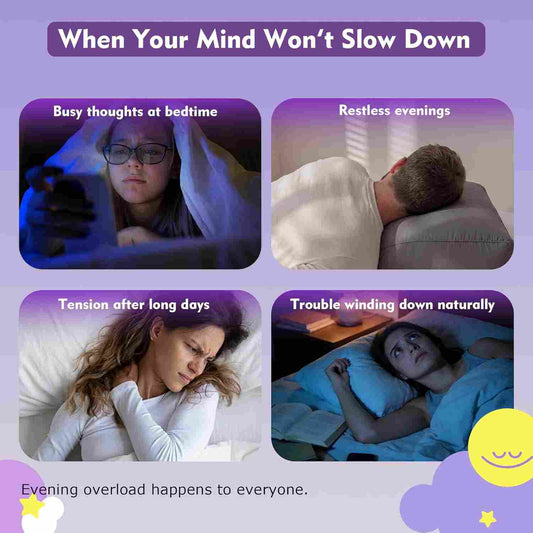
It is aimed squarely at people who need a runway between work and sleep. The honest starting point for nighttime wind-down is that most people are not short of information, only of a routine.
What follows keeps the jargon to a minimum: what nighttime wind-down is understood to do in the body, what a serving looks like, and how to judge a label properly. Winding down is a sequence of signals, and the body reads light, temperature and food as part of it.
The mechanism behind nighttime wind-down
This is the part most labels skip, and it is the part that decides whether nighttime wind-down is worth a place in your routine. Magnesium, apigenin and L-lysine are the inputs that support the calm side of the nervous system in the evening.
This is why nighttime wind-down works as part of a set rather than as a single hero ingredient. It pairs with dimmed lights and a consistent bedtime, which do the heavy lifting.
What to look for before you buy
-
Look at the amount per serving, not the total blend weight. An evening serving taken with your last meal, as a daily habit rather than something you reach for when it is already late.
-
Timing is the part of this category you actually control. Take it once a day, at a time you will still remember in a busy week..
-
Take it with food. Almost everything in this category is easier on the stomach alongside a meal.
If you only change one thing after reading this, make it the timing rather than the dose.
The boundary
This is a collection page, not a clinic. If sleep is not improving after a month of consistent routine, ask a doctor rather than escalating the dose.
These statements have not been evaluated by the Food and Drug Administration. This product is not intended to diagnose, treat, cure or prevent any disease.
Keep reading on sleep and calm
Common questions
What should I look for when comparing nighttime wind-down?
With nighttime wind-down, the number to compare is what one serving actually carries. If the ratio or the extract strength is missing, that tells you something too.
Should nighttime wind-down be taken every day?
For everyday use, the practical answer is the same slot each day, so it stops being a decision. If you take prescription medication, that is a pharmacist question rather than a label one.
Are there any interactions to watch for when taking nighttime wind-down?
Anyone on prescription medication should raise nighttime wind-down with a pharmacist or doctor before starting, because interactions are a real category. Nothing here is intended to diagnose, treat, cure or prevent any disease.
Built on the assumption that you would rather know what is in the bottle than be told how to feel about it.